Printable Starling Mask

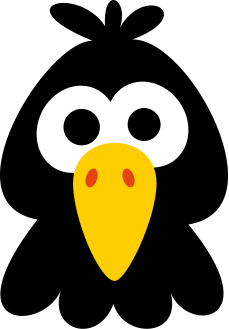
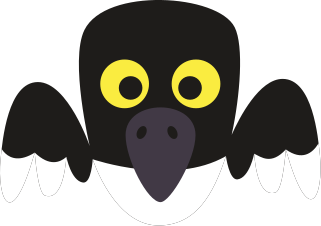
printable starling mask for kids

Iridescent, noisy and one of nature's greatest collective performers - our printable starling mask celebrates one of Britain's most spectacular and underappreciated birds! The starling may not be flashy in isolation, but in a murmuration of thousands - wheeling and swirling as one perfect liquid mass - it becomes something truly breathtaking. Perfect for British birds school plays, garden wildlife classroom projects, World Book Day, birthday parties, and dazzlingly coordinated imaginative play.

The murmuration is one of the natural world's great spectacles and a brilliant hook for topics on collective behaviour, communication and the science of how thousands of birds can move as one without a leader giving instructions. Every mask comes with a full colour version AND a black and white line art version for colouring in.
5 Interesting Facts About Starlings!

  • Starling murmurations - those breathtaking swirling formations of thousands of birds - follow simple rules: each bird tracks and matches the movements of its seven nearest neighbours. No leader, no choreography, pure emergent complexity.
  • Starlings are extraordinary mimics - they can copy the calls of over 20 other bird species, as well as mechanical sounds, telephone ringtones and even fragments of human speech. Mozart kept a pet starling that could sing parts of his Piano Concerto in G major.
  • Their feathers are iridescent without containing any colour pigment - the green and purple sheen is produced by the microscopic structure of the feather, which diffracts light differently at different angles.
  • Starlings introduced to North America in 1890 now number over 200 million - all descended from 100 birds released in Central Park by a Shakespeare enthusiast who wanted America to have every bird mentioned in Shakespeare's plays.
  • They are one of Britain's fastest-declining bird species - the UK population has fallen by over 80% since the 1970s due to loss of rough grassland for foraging. They are now on the red list of birds of conservation concern.